Understanding Leaf Curling in Calathea and Maranta
Leaf curling is one of the most common issues seen in Calathea and Maranta. It is often interpreted as a watering problem, but in most cases, it reflects a broader environmental imbalance.
These plants respond quickly to changes in moisture, humidity, and temperature. Curling is an early indicator that conditions are no longer stable.
Moisture Stress
The most frequent cause of curling is inconsistent moisture.
When the growing medium dries too far, the plant reduces surface area by curling its leaves to limit moisture loss. This response can occur rapidly, particularly in thinner-leaved varieties.
Plants such as Maranta leuconeura var. erythroneura will often show this behaviour within a short period of drying.
Overwatering can produce a similar appearance. In saturated conditions, roots are unable to function effectively, and the plant responds as if it were dry.
Humidity Fluctuation
Calathea and Maranta are adapted to environments where humidity remains relatively stable.
In dry indoor air, particularly when combined with heating or cooling systems, leaves begin to lose moisture faster than the plant can replace it. Curling is often followed by browning at the edges.
Highly variegated forms such as Calathea ‘Yellow Fusion’ tend to show this more quickly due to their reduced chlorophyll and thinner leaf structure.
Temperature Stress
Sudden drops in temperature or exposure to cold drafts can trigger curling.
These plants are not tolerant of low or fluctuating temperatures. Even short exposure to cooler conditions can cause a visible response in the foliage.
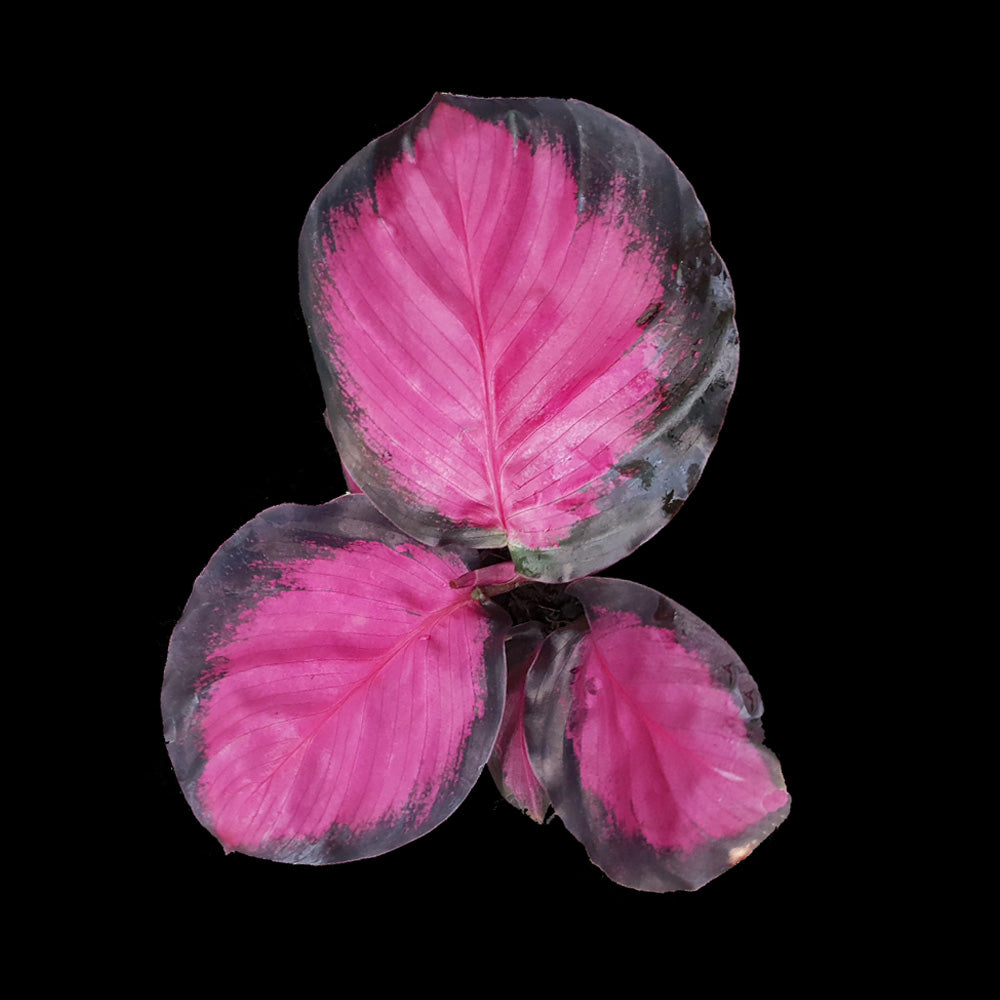
Broad-leaved varieties such as Calathea roseopicta ‘Rosey’ often show curling alongside general leaf softening when stressed.
Airflow and Environment
While these plants benefit from humidity, they do not perform well in stagnant environments.
Poor airflow can lead to ongoing stress, particularly when combined with high moisture. This often results in a cycle of decline rather than recovery.
Plants such as Calathea elliptica require a balance of humidity and airflow to maintain healthy foliage.
For more on suitable environments, see Indoor Terrarium Plants for Beginners.
How to Correct Leaf Curling
Correction depends on identifying the underlying cause rather than applying more water or increasing humidity indiscriminately.
- Check moisture levels and adjust watering frequency
- Stabilise humidity rather than increasing it temporarily
- Avoid temperature fluctuations and cold drafts
- Ensure the growing medium is not compacted or waterlogged
In most cases, restoring stable conditions leads to gradual recovery.
Summary
Leaf curling in Calathea and Maranta is not a single-issue problem.
It reflects instability in moisture, humidity, or temperature. Addressing these factors together, rather than individually, is the key to long-term success.
For complete growing conditions, see the Calathea & Maranta Care Guide.